
'Page the Quints'
Old scrapbook reveals fertile fragmentation

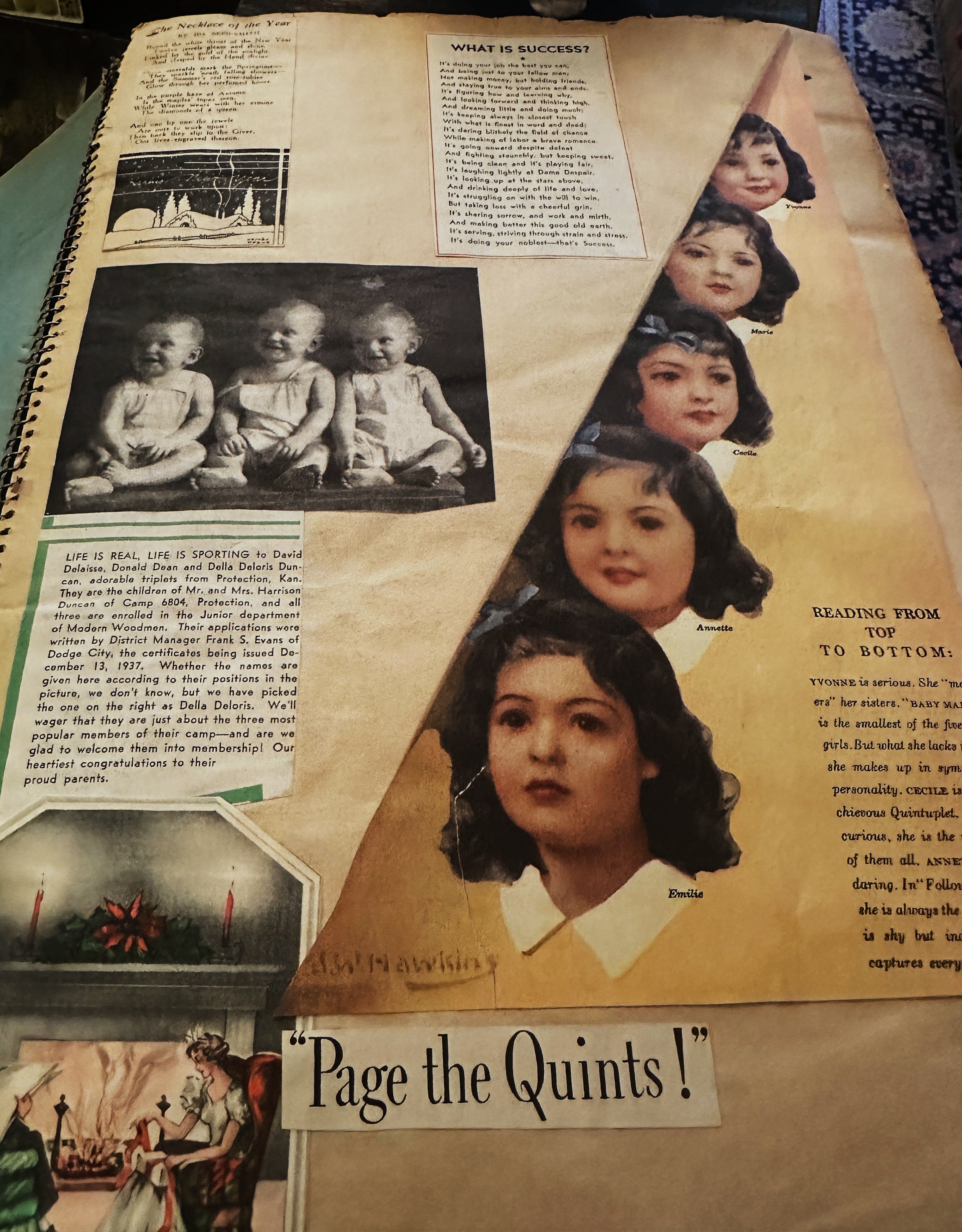
The thick scrapbook was an oddity.
Name-free and unnamed, let’s call it “Page the Quints.”
It was filled with, and surrounded by, fragments.
Nestled among a curated selection of well-preserved artifacts in a Willamina, Ore., collectibles shop, was this tattered book full of clippings and printed memorabilia.
The store, a corner bank in days gone by, mixed old and new, with modern decorative and gardening products, soaps, honey and jam, and other hand-crafted items perishable and otherwise. The old bank vault now serves as a small wine cellar – a common sight. (Surely there is a vintage store or two out there called Days Gone Buy.)
This day I found signs, books, puzzles, toys and board games – products of the past both pristine and worn, most of them copyrighted or manufactured but remaining in original state.
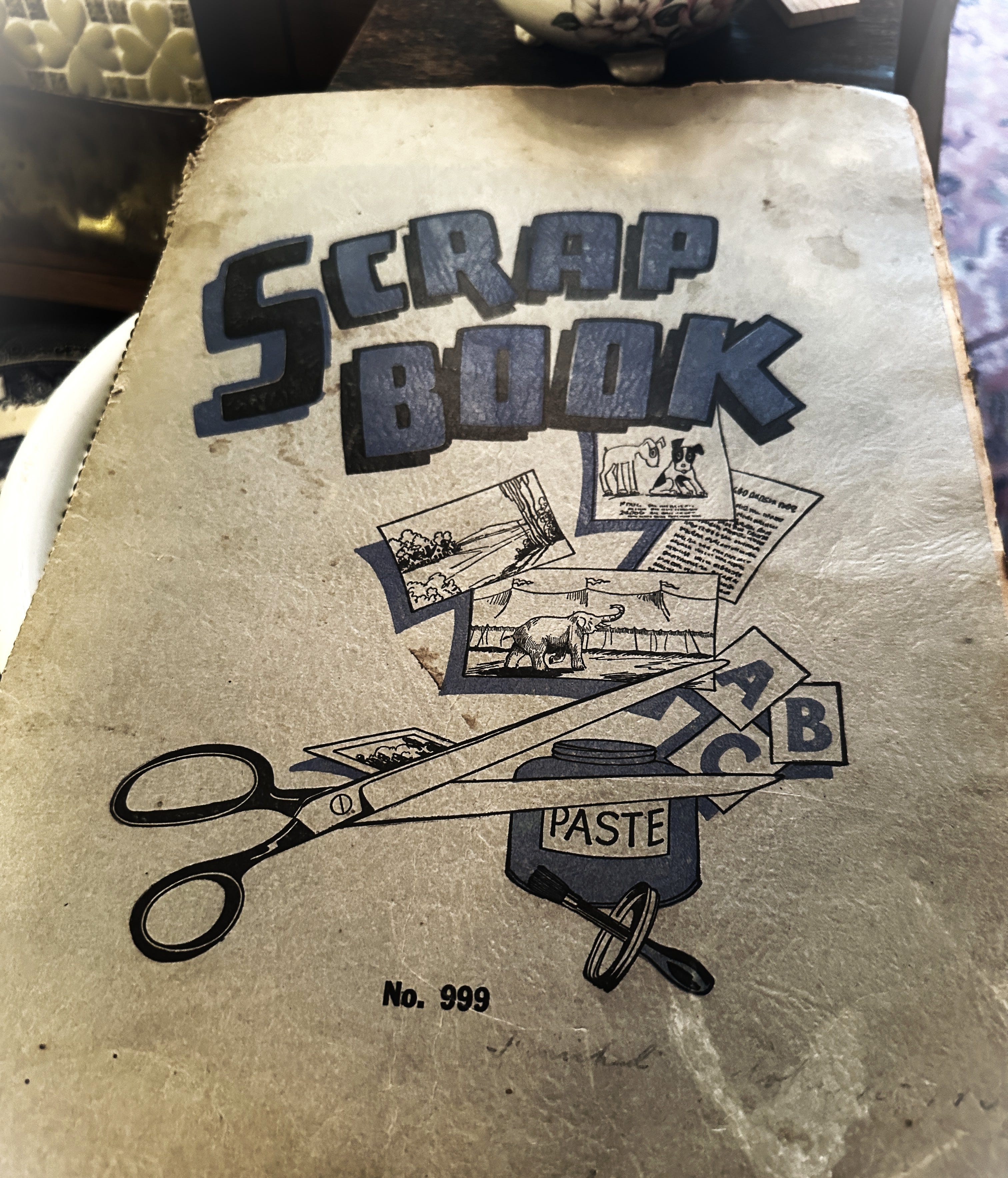
Then I found the 14-by-20 volume, the words “Scrap Book,” and “No. 999” on the cover.
^^^
Made of flimsy construction paper stock, “Page the Quints” had once been new and fresh on some dime store or stationers’ shelf but now bulges with someone’s clippings and other adopted memory material, from the late 1930s and early ‘40s.
Printed on the cover were images like “suggestions”: a country landscape, two dogs, a circus elephant.
But the inside was stuffed with disparate but unusual ephemera, much of it following a distinct theme.
One thing that distinguishes the book is the lack of musty odor – indicating an effort to preserve it. Someone had filled it with newspaper and magazine clippings, a postcard or greeting card or two, a poem or a cartoon – but mostly clippings. Most are firmly affixed but a few loose items fell to the floor when I opened it.
(Always an odd experience when something like that happens. I was once visiting a museum, and stopped to look at a recently donated desk from a jeweler’s office. Idly opening a drawer, I found numerous small tools of the trade, loose and as-yet unrecorded.)
Further fragmentation in the Quints book: subjects include a waterwheel in Illinois, an article about four eclipses in the next year (1939), a joke about two Irishmen and a well, a poem “Take A Walk Around Yourself,” and lists of oddities (“the eye of the butterfly contains about 5,000 different lenses”).
What is missing are indicators of ownership: no names, original photos or even handwriting. It is not that type of scrapbook.
Yet someone’s interests are displayed, a personality suggested.
^^^
The contents fall into two general categories, starting with scenic photos/farming. It’s too varied to provide any specific insight.
It is that second category of clippings, a poignant one, that dominates this anonymous scrapbook. That is why I call it “Page the Quints”. The phrase is glued to the first page with a photo of the Dionne sisters, born in 1934, the first quintuplets known to have survived infancy. They became media stars at their government-funded (and controlled) rural nursery.
One photo has the headline “Here’s the latest picture of the quints: Now confined to their nursery with colds!”
And that is just the start.
It is family that defines “Page the Quints!”– large families, those with multiple children.
Headlines include “Seeing double? No, twins” and “Oldest and Youngest Twins at Fete at Chardon, Ohio”
“Twins are 93 years old”: celebrates David and Joseph Maddox of Philo, Ill., “possibly the oldest living twins” in one undated photo, likely from the late 1930s.
Another full-page magazine clipping is multiple images of the Perricone quadruplets of Texas, born on Halloween night, 1929 – Anthony, Bernard, Carl and Donald – “the only male quadruplets living in the United States.” From the photos you would never guess they are quadruplets. “Medical men are puzzled by their complete physical dissimilarity,” states one caption.
Other stories include a couple who had 17 children in the span of 20 years, four brothers who married the four daughters of another family, and more photos of the Dionne five.
Whoever compiled this burgeoning volume must have been fascinated with the prospect of multiple births; the overriding theme, for lack of a better term, makes the anonymity of the scrapbook all the more intriguing. Who put it together? I speculate it was someone who themselves was a twin or a triplet.
More likely, someone was encouraged by the birth of the Dionnes, a landmark event of global interest. In 1939 the scrapbook owner would not know that their lives at age 5 were already troubled nor that their life conditions would become worse thanks to a combination of government intrusion, parental neglect, emotional abuse, what appears to be financial fraud and much more.
Perhaps the chroniclers ran out of room or decided to stop short in their collection. What is not in the book is the 1940 LIFE magazine article headlined “The Dionne Quintuplets: Little Girls Lost in the Harsh Glare of Fame.”
— N.R.