
Subject: Cento
Hunting and skimming through fragments

When I started looking into fragmentation, I had a notion that it was somehow an invention of mine, or something I was imagining or contriving into some kind of reality. Then I began to learn of or detect fragmentation in many forms, such as historical, literary, philosophical and artistic.
I turned, or found myself turned to, theoretical interpretations, such as “fragments are fundamentally relational,” from William Duba, Fragmentology publication author.
Duba who wrote that, “for fragments of manuscripts, and early print, those relations are between the fragment, the original object and their current functional whole that they (help) constitute the ‘carrier’, ‘host volume’, ‘loose leaf’, etc. Those objects, their context, and the events that brought them about are interrelated and irreducible.”
Learning about fragmentation and its esoteric theories and examples more or less accompanied the personal and practical examples I saw around me every day. I believe I self-attuned to these through reading as well as the help of those twins, Observation and Attention.
Fragmentation of my own invention included my daybook of book excerpts, Randomary: 365 separate book excerpts, randomly chosen, pages 1-366. But specific, cogent examples of fragments in action came to my attention over time. Moving forward I will highlight specific examples of fragmentation, ranging from ancient and modern poetry to random phenomena in nature.
^^^
I had never heard of Cento – a poem from lines cut out and borrowed from lines, until my friend Peter Cavanaugh sent me a clipping, with the note: “New York Times article is interesting about turning newspaper articles into literature. Thought you might like to try it.”
He knows I go for fragments.
Writer Leah Umansky describes the nature of Cento – 16th century Latin for patchwork – as “crafted from ‘stolen’ or found, sources. Each line in a cento is taken from a source and putting these lines together weaves them into a patchwork of lines.”
Cento is fragmentation in action. There are instructions: “Hunt or skim through the paper for lines that speak to you. Maybe your eye will settle on a sentence that used interesting language, like a vibrant verb or a compelling adjective; maybe you will find a sentence that includes a description of an image you admire or maybe you will find a line that refers to something that resonates with you, like a mention of a season, a color or an emotion. Keep hunting for your treasured lines. You may already have a topic in mind, or your topic may come to once you have your lines cut out and you really examine them.”
“Then you cut them out, make record of the sources, and lay them out, move them around, rearrange until inspiration finds its way to a finished poem using those lines (or others you replace them with.)”
It felt somewhat contrived to me but I tried it. It forced me to focus on words and phrases as they functioned on their own as well as in concert with unconnected others. Both challenge and release – in keeping with the yin-yang dynamic in most fragmentation.
What was on my mind before I started, and what stood out for me, was the state of the nation and the world in October 2025.
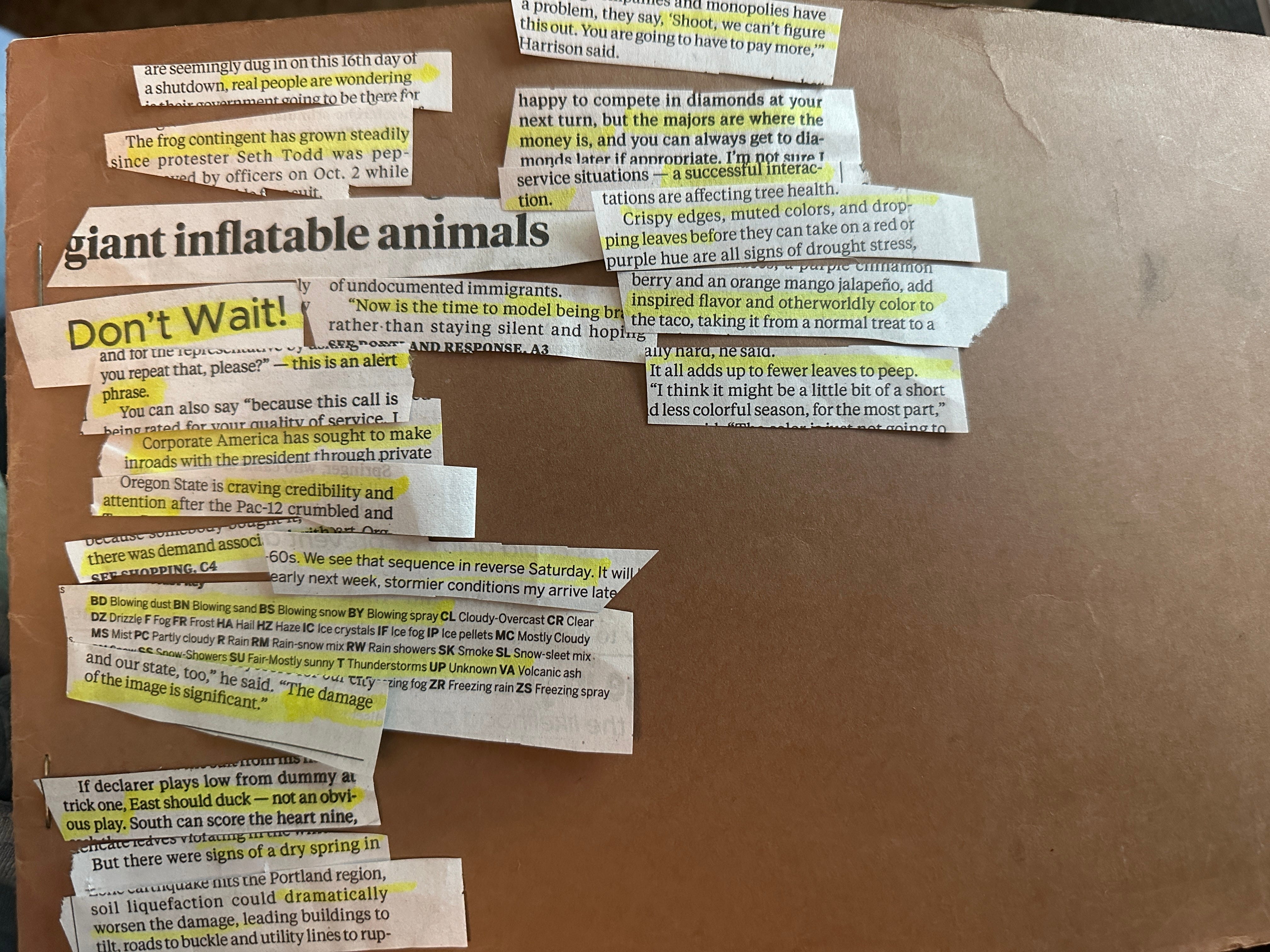
I call it “BY Blowing spray”:
Real people are wondering.
The frog contingent has grown steadily.
Giant inflatable animals Don’t wait!
Now is the time to model being brave – this is an alert phrase.
Corporate America has sought to make inroads with the president
Craving credibility and attention. There was demand associated with it.
The damage of the image is significant.
BS Blowing dust BN Blowing sand BS Blowing snow BY Blowing spray
We see that sequence in reverse Saturday.
East should duck – not an obvious play but there were signs of a dry spring in the Portland region soil liquefaction could dramatically worsen the damage.
“Shoot, we can’t figure this out. You’re going to have to pay more.”
but the majors are where the money is a successful interaction.
Crispy edges, muted colors and dropping leaves add inspired flavor and otherworldly colorful
It all adds up to fewer leaves to peep.
Cento now strikes me as an example of fragmentation as something appreciable and distinct – among so many instances I have detected, or practiced. There is such a meta sense to fragmentation: it presents itself as something whole, a resolution of mixed ideas or influences.
And as I thought some more about my exercise in fragmenting, the Randomary project, I realized the resonance of the instructions for Cento, or one line of its instructions:
“Hunt or skim through the paper for lines that speak to you.”
That is also what I did, in books, to compile Randomary.
I hunted or skimmed through books for lines that spoke to me.
Today is Oct. 19. The Randomary selections I chose, somewhat randomly, hence the name, from Oct. 19-21, the 292nd, 293rd and 294th days of the year, are these:
Page 292: “The Seven Drummers stood at the west end of the longhouse, facing east. Each held a drum that contained his song, one inherited from his ancestors Although five of the drummers were elders from various river bands, two were young, and Danny felt a twinge of envy that their family songs had been preserved.” -- Craig Lesley, “RiverSong,” St. Mark’s Press, 1989
Page 293. “Night was falling, and Peter was trotting almost running to keep up with Hawkins. The long-legged postman was clearly eager to be done with his rounds: he darted from house to house, dropping letters into the front-door mail slots, preoccupied with his task, which was fortunate for Peter, who was trying to remain unnoticed, blending into the homebound pedestrian throng while keeping close enough to see whether any of the envelopes was marked with an X.” --Dave Barry and Ridley Pearson, Peter and the Shadow Thieves,” Hyperiod Books for Children, 2006
Page 294: “There was one brief chuckle -- from Lance Clay, I think. But the rest of the auditorium fell into a sullen confused silence. And as Peter began to drone passionately on about the Cold War and atom bombs, about Hiroshima and hate, about the emptiness of victory and the fullness of emptiness and Russia and Buddha and the hidden purpose of life, even I, who loved him, wanted to drop down on the floor and crawl out the back door on my belly. It seemed he might go on forever when coach Donny Bunnel stood up in disgust, physically shouldered him away from the microphone, grinned out at the audience and said, ‘Off to Siberia with that one!’ “-- David James Duncan, “The Brothers K,” Bantam, 1996
Connections in Randomary often happened by apparent chance on “consecutive” pages within disparate, unrelated texts. Some blatant, some latent. In this case, these isolated fragments contain a common context,, in view of some respective phrases: “felt a twinge of envy”… “keeping close enough to see” … “it seemed it might go on forever”. I see observance of ritual or community practice: shared songs and stories, delivery of mail and speaking in a public meeting.
Essayist Sinead Gleeson quotes writer Donald Barthelme: “Fragments are the only forms I trust.”
Gleeson adds, “It’s hard not to argue with that. Their self-containedness makes them arrows of truth, unreliant on other paragraphs to illuminate a bigger story. Not boulders, but a collection of meteorites …”
Pointing out that individual strength is, to me, both argument and agreement, polarities supporting each other. So like fragments.
— N.R.